
AI Search / HVAC / 9 min read
How ChatGPT and Claude decide which HVAC contractor to recommend.
To improve your chances of being recommended by ChatGPT, make it easy to find and verify your services, location, credentials and reputation. Start with accurate public records, useful service pages and genuine customer reviews. Then test whether you appear across repeated searches.
There is no guaranteed placement. OpenAI says ChatGPT ranks search results using multiple factors intended to help people find relevant, reliable information, and that placement is not guaranteed (OpenAI's guide to searching the web with ChatGPT).
For an HVAC contractor, the useful question is therefore practical: when someone asks an assistant who can repair their AC or replace their furnace, what evidence can it find about your business? An October 2026 study provides clues, and some reasons to question confident sales pitches.
What the research actually found
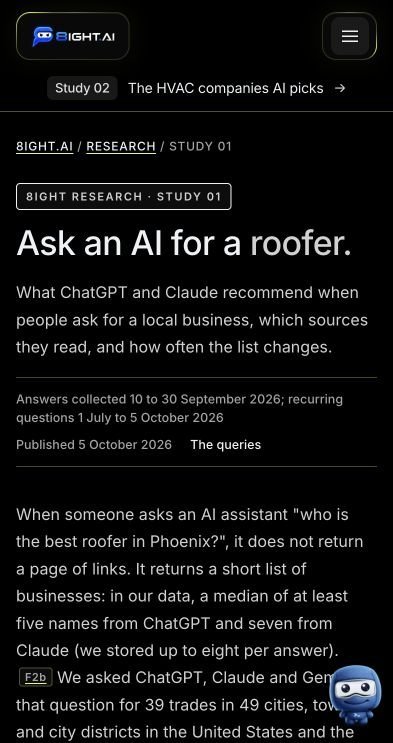
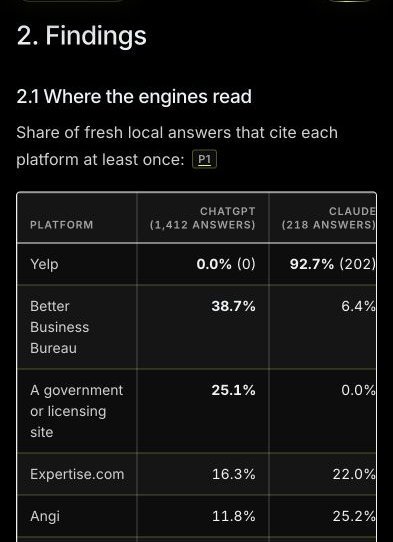
8ight.AI's study analysed 1,630 fresh answers about local trades: 1,412 from ChatGPT and 218 from Claude.
| Finding | Reported result |
|---|---|
| ChatGPT answers citing the Better Business Bureau | 38.7% |
| ChatGPT answers citing government or licensing sites | 25.1% |
| ChatGPT answers citing Yelp | None |
| Claude answers citing Yelp | 202 of 218 |
| Businesses with 1,000+ Google reviews named by ChatGPT | 22.2% |
| Businesses with fewer than 25 reviews named by ChatGPT | 3.4% |
Named and unnamed businesses both had a median rating of 4.9 stars. That does not establish that ratings never matter; it means rating alone did not separate them in this sample.
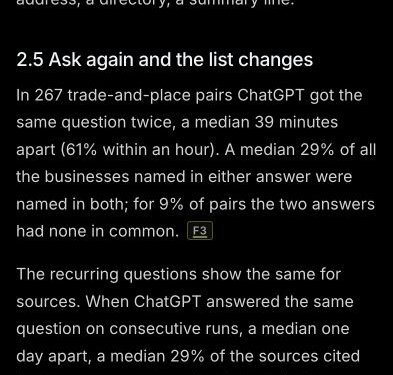
Across repeated ChatGPT questions, asked a median 39 minutes apart, only a median 29% of the businesses named in either answer were named in both.
These were API tests with web search, not tests in the consumer apps. The findings span many trades, not HVAC alone. Most fresh answers came from two September days, and many scheduled checks failed for billing or quota reasons on the researcher's side, which shrank Claude's sample. The business sample was not random. 8ight sells AI-visibility services: this is one commercially produced snapshot, not a causal experiment or a published ranking formula. Citations show linked sources, not everything a model used.
How an AI recommendation gets assembled
When web search is involved, the assistant can retrieve current information and use it to construct an answer. Anthropic describes Claude processing multiple sources and replying with direct citations (Anthropic's web search guide). That gives you two things to work on:
- Discovery: can the system find information about your company?
- Verification: does that information clearly support recommending you for this particular job?
A page saying "your trusted comfort experts" does little to establish whether you repair heat pumps in a specific town. A page naming the service, explaining your coverage, identifying the business and linking to verifiable credentials gives both a homeowner and a search system something concrete to assess.
The steps below are practical improvements to that evidence. They are not confirmed algorithm weights.
1. Make your licence easy to verify
Where your work requires a licence or registration, check the public record kept by the relevant authority. Search for your business as a homeowner would. Does the record identify the correct company, show the current status and connect clearly to your trading name? Then make the connection explicit on your website:
- Name the licensed business or licence holder accurately.
- State the licence number and the issuing authority.
- Link to the official lookup or public record where possible.
- Explain any difference between your legal name and your customer-facing brand.
For example, customers might know you as "Clearview Heating & Air" while the register lists a different legal entity. Explain that relationship instead of leaving readers to guess. Requirements differ by location and type of work, so treat the authority's record as the source of truth.
This is also a conversion improvement: someone checking your credentials should be able to finish the job without calling your office.
2. Check BBB and relevant directory profiles
Review your BBB profile if one exists. Confirm the business identity, website, contact details and service description. Keep any claims about accreditation accurate: a profile and paid accreditation are different things, and the study does not show that buying accreditation produces AI recommendations.
Apply the same discipline to Yelp and the other directories that matter in your market. A useful profile should help someone answer four questions:
- Is this the right company?
- Does it serve my location?
- Does it handle my type of system or job?
- How do I contact it?
Prioritise accurate, relevant profiles over dozens of listings you cannot maintain. Also check manufacturer dealer directories and trade-body listings where your company genuinely qualifies. If you call yourself an authorised dealer, make that claim easy to verify.
3. Build a steady process for genuine reviews
Do not turn the research into a target of "get 1,000 reviews". A better goal is to give every customer a consistent opportunity to describe their experience, within each platform's rules.
Where review requests are permitted, make them part of the completed-job workflow. Do not pick only the customers you expect to leave five stars, buy reviews or hand customers a script to copy. Useful HVAC feedback naturally answers what future buyers want to know:
- Did the technician arrive when expected?
- Was the diagnosis explained clearly?
- Were the proposed costs understandable?
- Was the installation completed properly?
- Did the company handle follow-up issues?
Do not coach customers to mention keywords. Let them describe what happened. And keep watching complaints and recurring service problems: reviews should support a better customer experience, not stand in for one.
4. Make your business identity consistent
Start with the details that could cause genuine confusion:
| Detail | What to check |
|---|---|
| Business name | Current trading name and any legal-name relationship |
| Phone number | A working route to the correct business |
| Website | The current domain and the relevant location page |
| Service area | Places your technicians actually cover |
| Services | Repair, replacement, maintenance and commercial work you genuinely offer |
| Opening hours | Accurate availability, including any emergency service |
| Credentials | Current, verifiable claims |
Consistency does not mean identical wording everywhere. It means every record describes the same business without conflicting facts. An old phone number, a closed branch or an unsupported "24/7" claim is a far bigger problem than a punctuation difference.
Our local SEO service covers these foundations alongside your website and map listings.
5. Give each important HVAC service a useful page
Someone asking for emergency AC repair has different needs from someone comparing heat-pump installers, and your website should make the difference clear.
- An AC repair page should explain the systems you service, your coverage area, how booking works and your real availability.
- A replacement page should explain how you assess a home, prepare a quote and discuss suitable options.
- A maintenance plan page should state what is included, what costs extra and how appointments work.
Use real project examples where you have permission: the customer's problem, the work completed and any constraints. Avoid invented results or generic claims that could belong to any contractor.
Also check that search systems can reach your pages. OpenAI recommends allowing OAI-SearchBot in robots.txt and allowing requests from its published IP ranges (OpenAI's crawler documentation). Eligibility still does not guarantee inclusion. Have your developer check both robots.txt and any firewall or CDN rules before you invest in more content.
6. Test it yourself with a repeatable method
One answer is an observation. A repeatable test is something you can make decisions with.
Choose questions your customers would actually ask
Start with a small set covering your main services and locations:
Search the web and recommend HVAC contractors for AC repair in [city]. Explain your choices and cite your sources.
Which companies install heat pumps in [city]? Include sources I can check.
Recommend HVAC maintenance providers serving [neighbourhood].
Keep the wording unchanged when comparing results over time, and do not include your company name in a discovery test. Separately, ask about your business by name to check whether the assistant describes it accurately.
Keep the conditions as consistent as possible
Use fresh conversations, make sure web search is on, and name the city rather than relying on "near me". Record the model where visible, the date, your location settings and whether memory is enabled. OpenAI says ChatGPT uses general location from your IP address and, if memory is on, may use saved memories when rewriting a search query (OpenAI's search guide). Test ChatGPT and Claude separately.
Save the evidence
| Field | What to record |
|---|---|
| Prompt | The exact question asked |
| Platform and model | Which system produced the answer |
| Date and settings | When, and under what conditions |
| Business mentioned | Yes or no |
| Sources | The exact pages linked |
| Accuracy | Incorrect services, credentials or contact details |
| Competitors | Other businesses named |
Repeat the questions on different days, and keep the answers where you are absent as well as those where you appear. Then calculate one simple measure:
Answers naming your business ÷ valid answers tested. Keep failed searches separate and always report the sample size with the percentage.
This is your own monitoring measure, not an estimate of your share of all AI searches.
Fix factual gaps before chasing mentions
Read the sources behind the answers. If an assistant describes your old service area, find the pages carrying that information. If it cannot verify a credential, check whether the public record is accessible and clearly connected to your business. Correct the underlying source where you can, note the change, and test again later.
A different answer straight after an edit does not prove the edit caused it. Keep a change log and look for patterns across many checks.
Measure whether recommendations become booked work
Visibility matters when it brings suitable customers. Add a neutral source question to your enquiry form and phone script, "How did you first hear about us?", with "ChatGPT or another AI assistant" as one option and room to add detail. If someone picks it, record which assistant and, where practical, what they asked.
Then track what happened next: qualified enquiry, booked visit, completed repair or accepted installation quote.
A customer may read an AI recommendation and then call directly or search your business name, so referral analytics alone will miss part of the journey. Combine analytics with customer answers and job records, as our guide to conversion tracking problems explains, and see how to measure AI search traffic for the analytics side.
What to ask an agency promising "#1 in ChatGPT"
Ask them to define the claim. Which question? Which city? Which model? How many tests? Was web search on? Are they measuring first mention, any mention, a citation, or an actual enquiry? Given that repeated questions in the study shared only around 29% of their names, a single screenshot proves very little.
A credible proposal explains the work, the testing method and its limits, and shows how visibility will be connected to qualified leads.
For your own business, start with a manageable audit: verify your public credentials, correct the important profiles, improve your core service pages and set a repeatable baseline. If you want help, our local SEO service brings those pieces together and measures whether better visibility leads to booked work.