
AI Search / SEO / 8 min read
AEO vs SEO: what Google actually says, and where ChatGPT is different.
For Google's AI search features, AEO is part of SEO, and Google says so explicitly. For ChatGPT and Claude, some additional work can be useful, because their discovery systems, sources and access controls differ. That distinction matters when someone offers you an "AI optimisation" package.
Improving your content, fixing pages that cannot be crawled and correcting your business information are concrete services. Adding an acronym does not tell you whether the proposed work is useful, or whether you are already paying for it. The right question is: which platform are we improving visibility on, and what specifically needs to change?
AEO vs SEO: the comparison
SEO means search engine optimisation. AEO means answer engine optimisation: work intended to help a business or its content appear in answers. GEO, generative engine optimisation, is another label for visibility in generated responses. These labels overlap. They do not describe three neatly separate technical disciplines.
| Question | Traditional Google SEO | Google AI Overviews and AI Mode | ChatGPT and Claude with web search |
|---|---|---|---|
| Intended outcome | Relevant visibility in search results | Inclusion or citation in generated answers | Accurate mentions, recommendations or citations |
| Where information comes from | Google's search systems | Google's Search index and core ranking systems, plus additional AI techniques | Each provider's own search and retrieval systems |
| Separate discipline needed? | Established SEO work | Google explicitly treats this as SEO | Platform-specific access checks, source research and measurement can add useful work |
| Special AI files required? | No | Google says it ignores llms.txt for Search | Do not assume a file helps without evidence the service uses it |
| Technical checks | Crawling, indexing, usable pages | Search eligibility and the AI inclusion setting | The relevant crawlers, retrieval access and hosting restrictions |
| Can other websites supply information about you? | Yes | Yes | Yes: inspect which sources actually appear |
| Does inclusion guarantee traffic or sales? | No | No | No |
The platform distinctions come from Google's AI optimisation guide, OpenAI's crawler documentation and Anthropic's crawler documentation.
Google directly addresses the AEO argument
Google's position is unusually clear:
"From Google Search's perspective, optimizing for generative AI search is optimizing for the search experience, and thus still SEO."
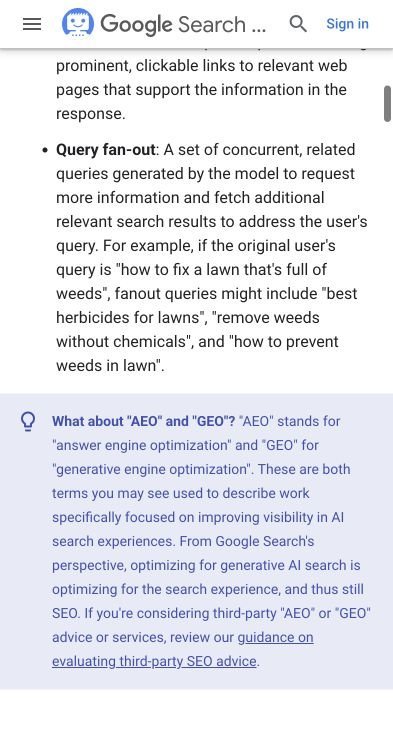
The guide explains that AI features draw on the Search index and the core ranking and quality systems. They can also run related searches, known as query fan-out, to gather material for an answer.
That does not mean an AI Overview simply reproduces the top few results as a paragraph. An answer assembled around several related questions can draw on a different selection of pages, so a strong conventional ranking is not a promise of an AI citation.
For a business owner, the distinction that matters is between a different search experience and a completely separate set of website requirements. The first is true. Do not accept the second just because the first is.
Special AI files
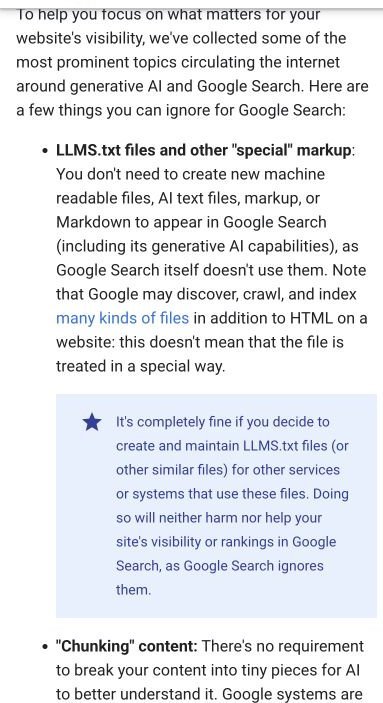
Google also says Search does not use llms.txt or other "special" AI files, and that content does not need to be chopped into small chunks. Creating such files will neither help nor harm your Google visibility; they may matter to other services that use them.
What useful optimisation looks like
Consider an HVAC company with a heat-pump installation page that promises "quality solutions at competitive prices" but does not explain which properties it serves, how it assesses an installation or what a quote includes.
Rewriting that page could be valuable. But the value comes from answering the customer's questions:
- What types of properties and systems do you work with?
- What happens during the survey?
- Which factors affect the proposed installation?
- What is included in the quote?
- What credentials can a customer verify?
- What happens after installation?
Add a real project example, with permission, and explain the decisions made. That gives a prospective customer something they can use, and gives any system retrieving the page more substance to work with.
Google's helpful content guidance asks for original information, clear sourcing and value beyond rewriting existing material. A shorter introduction and clearer headings may improve the page. They cannot replace missing expertise.
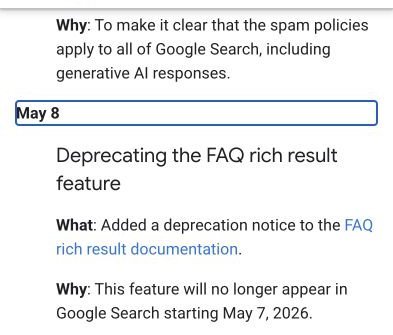
FAQ rich results ended on 7 May 2026
Google's changelog confirms that FAQ rich results stopped appearing in Google Search from 7 May 2026, and the documentation for the feature was removed on 15 June.
If an audit still promises expanded FAQ listings in Google as the benefit of adding FAQPage markup, that recommendation needs updating. But three different things often get confused:
| Item | What it does |
|---|---|
| Visible questions and answers | Help readers find information |
| Structured data | Describes information in a machine-readable format |
| A Google FAQ rich result | Was a particular search-result display; it has been retired |
Google separately documents using structured data to understand page content. That general purpose is distinct from eligibility for a particular display, and it does not show that FAQ markup now gives an AI citation or ranking advantage.
Keep useful answers because customers need them. For an HVAC maintenance plan, questions about visit frequency, exclusions and cancellation terms help. Twenty questions repeating your company name and service area do not.
Where ChatGPT and Claude genuinely differ
Google's explanation covers Google Search. It should not be stretched into a claim that every AI assistant works the same way.
OpenAI separates OAI-SearchBot, used to surface websites in ChatGPT's search features, from GPTBot, used for model training. Sites that block OAI-SearchBot will not be shown in ChatGPT search answers (OpenAI's crawler documentation). Anthropic likewise distinguishes three agents:
- ClaudeBot: collects content that could contribute to model training.
- Claude-SearchBot: indexes content to improve search results.
- Claude-User: fetches pages when a person asks Claude a question.
Anthropic says blocking the last two may reduce your visibility in search answers (Anthropic's crawler documentation).
That creates a legitimate technical task: check which systems can reach your site and whether those settings match your intentions. Ask your developer to look at both robots.txt and hosting security, because a crawler allowed in robots.txt can still be stopped by a firewall challenge. Treat training access and search discovery as separate decisions; "allow every AI bot" is too blunt a recommendation.
Third-party profiles deserve attention, but "matter more" needs evidence
An assistant can describe your business using information published elsewhere, so your own website is only part of what is worth checking. And source choices vary a lot between platforms.
In an October 2026 study of local-business answers, 8ight.AI reported that ChatGPT cited the BBB in 38.7% of its answers and government or licensing sites in 25.1%. Claude cited Yelp in 202 of 218 answers; ChatGPT did not cite Yelp in any of the sampled answers.
These were API tests with web search across many trades, not a controlled experiment showing that changing a listing causes more recommendations. The publisher sells AI-visibility services, and the findings are one snapshot. The defensible conclusion is to investigate which sources appear for your market on each platform, not that reviews or directories universally carry more weight in AI answers than in Google rankings.
For a local business, a sensible audit covers:
- Relevant licensing and registration records.
- Important directory and review profiles.
- Manufacturer or professional-association listings.
- Accurate business names, contact details and service areas.
- Outdated claims that could mislead a customer.
Prioritise sources with a genuine connection to your business. Hundreds of weak listings are not a substitute for accurate evidence. Our guide to how ChatGPT and Claude choose an HVAC contractor applies this to contractor recommendations.
How to measure the work
A useful report separates three outcomes:
- Visibility: did the business or page appear?
- Accuracy: was it described correctly?
- Commercial value: did the exposure lead to suitable enquiries or sales?
For Google, use Search Console, including its Generative AI performance report. For ChatGPT, links in its answers have carried utm_source=chatgpt.com, which helps identify those visits in analytics. The OpenAI publisher page that described this has since been retired, so confirm in your own reports that the tag still arrives.
Alongside referral data, run a small, repeatable set of customer questions. Record the platform, model where visible, date, exact prompt, cited pages and whether your business appeared. Keep settings consistent and keep the unsuccessful tests. Do not present that sample as your share of every AI conversation.
Then connect enquiries to outcomes. A mention that brings unsuitable calls is worth less than a smaller number of qualified enquiries that become jobs. Our guides to measuring AI search traffic and conversion tracking problems cover the detail.
What to ask before buying an AEO service
Ask for the proposed work in plain language:
| Proposed service | Question to ask |
|---|---|
| "AI-ready content" | Which customer questions are currently unanswered? |
| "AI technical optimisation" | Which access or retrieval problem have you found? |
| "Schema optimisation" | Which supported use does this markup serve? |
| "Authority building" | Which relevant sources need correcting or improving? |
| "AI visibility tracking" | Which prompts, platforms and repeated tests are included? |
| "Guaranteed recommendations" | What exactly is guaranteed, and what evidence supports it? |
A separate service can be justified when it contains additional work: checking different crawlers, investigating external sources, testing answer accuracy or measuring a new referral channel. It is much harder to justify when the deliverables are existing SEO tasks with new names and a second invoice.
You do not have to choose between search visibility and AI recommendations. Start with the specific gaps in your content, access, public information and measurement. Our SEO service works on those concrete improvements, prioritised by the customers and enquiries your business needs.